TWO:Plotinus is driven by this perplexity to reconsider the whole theory of Matter.477 He takes Aristotle¡¯s doctrine as the groundwork of his investigation. According to this, all existence is divided into Matter and Form. What we know of things¡ªin other words, the sum of their differential characteristics¡ªis their Form. Take away this, and the unknowable residuum is their Matter. Again, Matter is the vague indeterminate something out of which particular Forms are developed. The two are related as Possibility to Actuality, as the more generic to the more specific substance through every grade of classification and composition. Thus there are two Matters, the one sensible and the other intelligible. The former constitutes the common substratum of bodies, the other the common element of ideas.478 The general distinction between Matter and Form was originally suggested to Aristotle by Plato¡¯s remarks on the same subject; but he differs325 from his master in two important particulars. Plato, in his Timaeus, seems to identify Matter with space.479 So far, it is a much more positive conception than the ?λη of the Metaphysics. On the other hand, he constantly opposes it to reality as something non-existent; and he at least implies that it is opposed to absolute good as a principle of absolute evil.480 Thus while the Aristotelian world is formed by the development of Power into Actuality, the Platonic world is composed by the union of Being and not-Being, of the Same and the Different, of the One and the Many, of the Limit and the Unlimited, of Good and Evil, in varying proportions with each other.Lawrence stepped into the garden, Mamie welcomed him eagerly. No books of hers were half so popular as the novelist's impromptu stories.
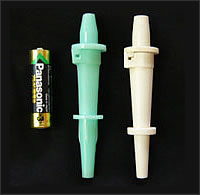
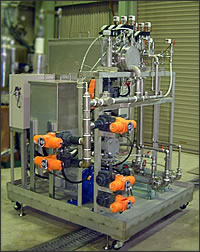
A hydrocyclone (liquid cyclone) injects treatment solution into stationary equipment to perform separation, classification, and concentration, and is an innovative separator with a very simple structure and no drive unit.
Structure of a hydrocyclone (liquid cyclone)
A suspension containing fine particles of several micrometers or more is supplied to a cylindrical container circumferentially at high speed. And as a result it starts to rotate and a centrifugal force is generated. At this time a gravitational acceleration of several tens of thousands of G is generated in the circumferential direction, and thus leading to fast sedimentation and concentration of the fine particles. The separated concentration can be freely selected by changing the supply rate (supply pressure and flow rate) and the flow ratio of the outlet. Our hydrocyclone (liquid cyclone) was designed and manufactured to classify and concentrate fine particles, and so has a small element.
THREE:Before entering on our task of reconstruction, we must turn aside to consider with what success the same enterprise has been attempted by modern German criticism, especially by its chief contemporary representative, the last and most distinguished historian of Greek philosophy. The result at which Zeller, following Schleiermacher, arrives is that the great achievement of Socrates was to put forward an adequate idea of knowledge; in other words, to show what true science ought to be, and what, as yet, it had never been, with the addition of a demand that all action should be based on such a scientific knowledge as its only sure foundation.87 To know a thing was to know its essence, its concept, the assemblage of qualities which together constitute its definition, and make it to be what it is. Former thinkers had also sought for knowledge, but not as knowledge, not with a clear notion of what it was that they really wanted. Socrates, on the other hand, required that men should always be prepared to give a strict account of the end which they had in view, and of the means by which they hoped to gain it. Further, it had been customary to single out for exclusive attention that quality of an object by which the observer happened to be most strongly impressed, passing over all the others; the consequence of which was that the philosophers had taken a one-sided view of facts, with the result of falling into hopeless disagreement among themselves; the Sophists had turned these contradictory points of view against one another, and thus effected their mutual destruction; while the dissolution of objective certainty had led to a corresponding dissolution of moral truth. Socrates accepts the Sophistic scepticism so far as it applies to the existing state of science, but does not push it to the same fatal con118clusion; he grants that current beliefs should be thoroughly sifted and, if necessary, discarded, but only that more solid convictions may be substituted for them. Here a place is found for his method of self-examination, and for the self-conscious ignorance attributed to him by Plato. Comparing his notions on particular subjects with his idea of what knowledge in general ought to be, he finds that they do not satisfy it; he knows that he knows nothing. He then has recourse to other men who declare that they possess the knowledge of which he is in search, but their pretended certainty vanishes under the application of his dialectic test. This is the famous Socratic irony. Finally, he attempts to come at real knowledge, that is to say, the construction of definitions, by employing that inductive method with the invention of which he is credited by Aristotle. This method consists in bringing together a number of simple and familiar examples from common experience, generalising from them, and correcting the generalisations by comparison with negative instances. The reasons that led Socrates to restrict his enquiries to human interests are rather lightly passed over by Zeller; he seems at a loss how to reconcile the alleged reform of scientific method with the complete abandonment of those physical investigations which, we are told, had suffered so severely from being cultivated on a different system.
- Equipment costs can be reduced.
- Operating costs can be reduced.
- Maintenance costs can be reduced.
- Any change in raw material and product can be easily addressed.
- Large amounts can be treated in a small area.
- Separation and cleaning are easy because of the simple structure.
- Simplified control
- This equipment can be operated in synchronization with external devices.
- Alarm and interlock mechanism.
THREE:Prout shook his head in a non-committal fashion. He had heard some amazing statements made by suspects in his time, statements so wild that they carried guilt on the face of them. And yet he had personally proved many of these statements to be true. The Countess smiled as she turned to the door.
- Classification and concentration for the manufacture of inorganic powder materials
- Classification of ceramic materials
- Removal of fine particles, including iron powder
- Removal of fine particles from pigments
- Removal of fine organic particles from solvents
- Separation of starch and yeast
- Removal of fine particles from high-temperature strong acid solutions
- Removal of fine particles from low-temperature solutions